
Course 01
Basic Astronomy and Celestial Mechanics
This first course introduces the astronomical, physical, and mathematical foundations required to understand the motion of celestial bodies.
Students will study the structure of the Solar System, Newton’s laws, universal gravitation, Kepler’s laws, and the classical two-body problem.
Course Objective
By the end of this course, students will be able to explain the motion of celestial bodies using the fundamental laws of mechanics and gravitation.
Main Topics
- Structure and scale of the Solar System
- Celestial coordinate systems
- Newton’s laws and universal gravitation
- Kepler’s laws of planetary motion
- The classical two-body problem
- Energy and angular momentum
Key Question
How do the laws of mechanics explain the motion of planets and satellites?
Course 02
Foundations of Astrodynamics
Understand the laws that govern satellite motion. Start with Astrodynamics Laws, the first complete module of Foundations of Astrodynamics.
Course II develops the physical foundations needed to predict satellite motion. Its first available module, Astrodynamics Laws, connects observations of planetary motion to the equations used in spacecraft engineering.
Section 1 · Astrodynamics Laws
Kepler describes the orbit: an ellipse with the attracting body at one focus, equal areas swept in equal times, and a period that grows with the size of the orbit. A satellite therefore travels faster near periapsis and slower near apoapsis.
T² = 4π²a³ / μ
Here T is the orbital period, a is the semi-major axis and μ = G(M + m) is the gravitational parameter of the two-body system. For an artificial Earth satellite, μ ≈ GM⊕. Orbits with the same a around the same primary have the same Keplerian period.
Newton explains the motion: inertia keeps the spacecraft moving, while gravity continuously bends its trajectory. Combining F = ma with universal gravitation gives an acceleration directed toward the primary, with magnitude μ/r².
r̈ = −μr / |r|³
Two conserved quantities make the motion easier to understand. Specific mechanical energy ε = v²/2 − μ/r determines the orbital size and whether the trajectory is bound. Specific angular momentum h = r × v fixes the orbital plane and explains Kepler’s law of areas. These quantities remain constant in the ideal, unperturbed two-body model.
A first application
Mars takes about 1.88 Earth years to orbit the Sun. Comparing its orbit with Earth’s gives a ≈ 1.88^(2/3) = 1.52 AU. The same period law helps engineers choose satellite orbits.
Continue with the complete module
The complete module includes nine lessons, step-by-step derivations, a circular-orbit calculator, worked examples and a self-check with explained answers. It also distinguishes orbital periods, explains free fall and develops the equation of relative motion.
Source: Richard L. Lachance, Ph.D., SꙨL Part II – Section 1 – Astrodynamics Laws. Basic algebra and vectors are recommended.
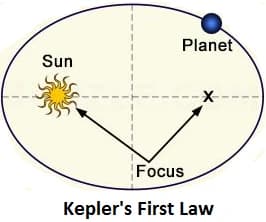
Source presentation, slide 28
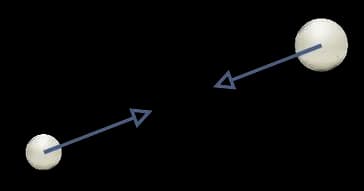
Source presentation, slide 50
Available in Dashboard → My courses. Sign in or create an account to read the lessons.
Course 03
Applied Astrodynamics and Space Situational Awareness
This third course extends the two-body model by introducing the perturbations and numerical methods required to analyze real satellite trajectories.
Students will also discover the principles of Space Situational Awareness, including satellite tracking, orbit prediction, conjunction analysis, and the monitoring of space debris.
Course Objective
By the end of this course, students will be able to analyze perturbed trajectories, apply numerical propagation methods, and explain how orbital data supports safe operations in space.
Main Topics
- Earth oblateness and the J2 perturbation
- Atmospheric drag and solar radiation pressure
- Third-body gravitational effects
- Numerical orbit propagation
- Satellite tracking and orbit determination
- Conjunction analysis and space debris monitoring
Key Question
How can we predict and monitor satellite trajectories in a perturbed orbital environment?
Course 04
Remote Sensing from Space: Orbit-to-Image Physics
The fourth course connects satellite orbit design with the physical principles of Earth observation and image acquisition from space.
Students will examine how orbital altitude, viewing geometry, sensor characteristics, and radiometric conditions influence image coverage, spatial resolution, and revisit time.
Course Objective
By the end of this course, students will be able to relate an orbital configuration and sensor design to the geometry and quality of a remotely sensed image.
Main Topics
- Principles of satellite remote sensing
- Observation geometry and line of sight
- Ground sampling distance and spatial resolution
- Swath width, coverage, and revisit time
- Radiometric and spectral considerations
- From orbital position to image geolocation
Key Question
How do the orbit and sensor characteristics determine what can be observed in a satellite image?